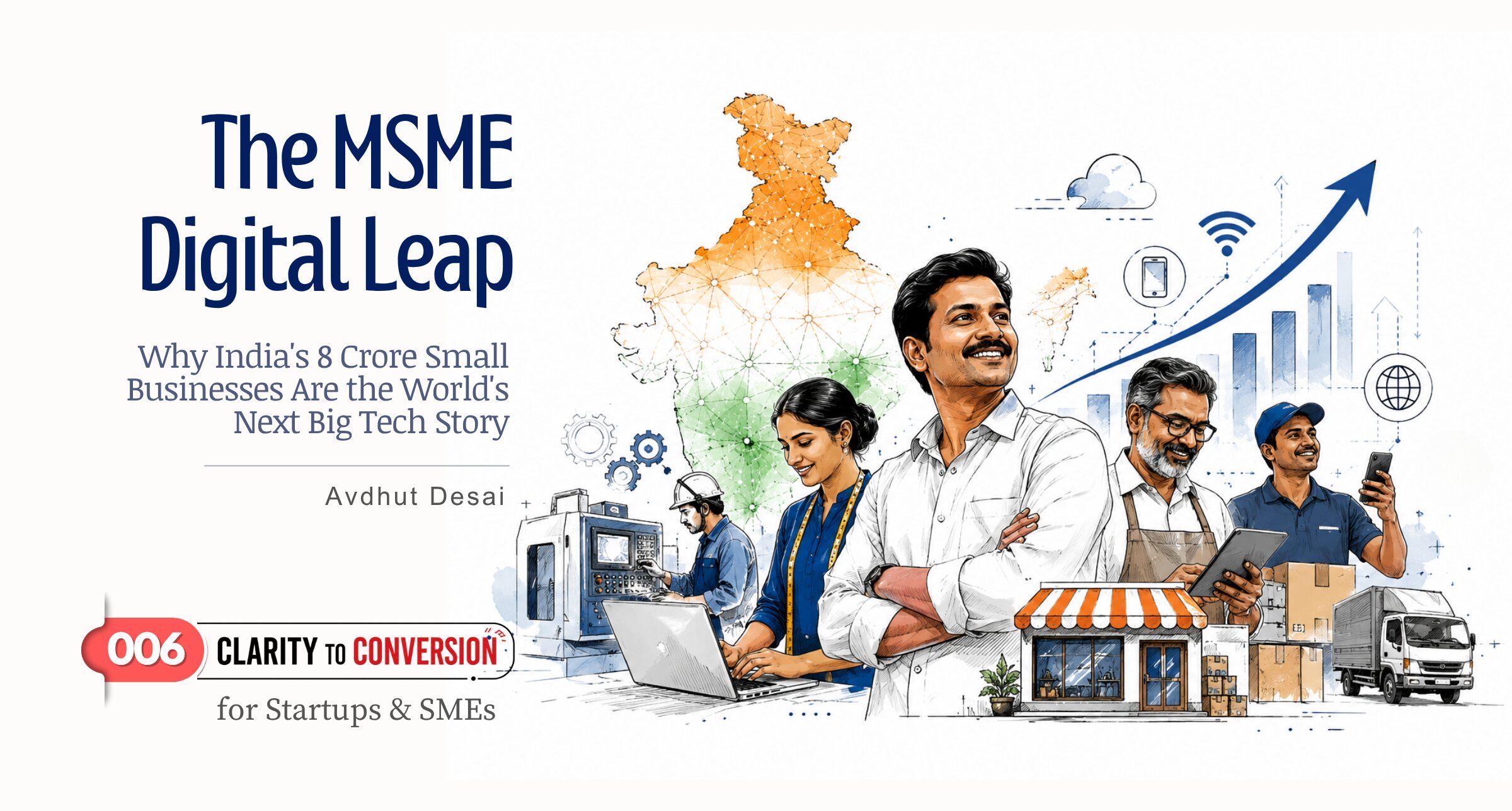
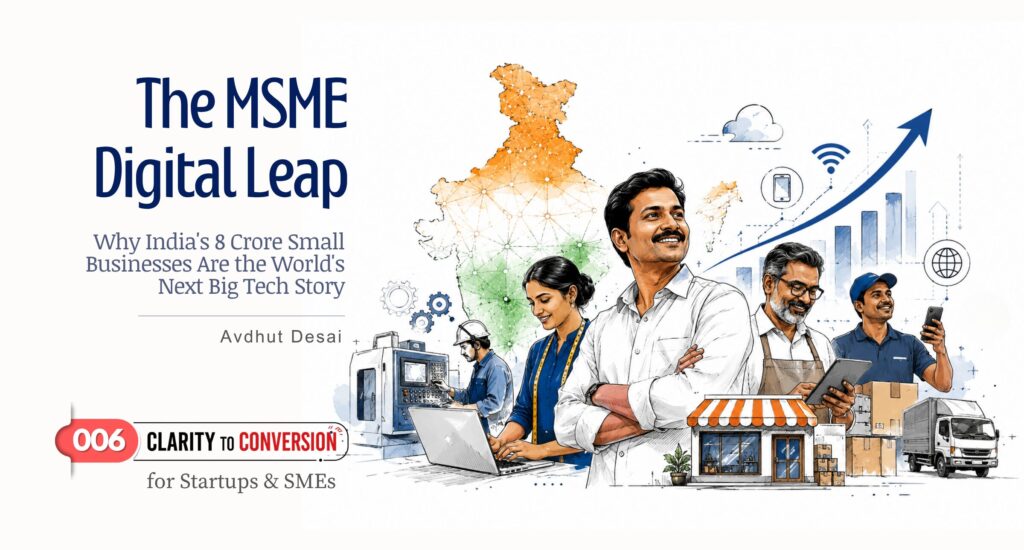
There is a number that tends to get lost in conversations about India’s rise as a global technology power: 8.7 crore.
That is the number of registered MSME enterprises in India today. Not startups. Not unicorns. Micro, small, and medium enterprises — the dhabas and the dyers, the toolmakers and the textile weavers, the software service shops and the surgical instrument manufacturers. As of the Economic Survey 2025–26, these enterprises collectively employ over 32.82 crore people, the number has increased significantly by now, making the sector the second-largest employer in the country, behind only agriculture.
Yet for decades, they were described as “the unorganised sector” — informal, fragmented, difficult to scale, and almost impossible to digitise. That story is being rewritten in real time.
India’s MSME sector now contributes 31.1% of the country’s GDP, accounts for 48.58% of all exports, and drives 35.4% of manufacturing output. These are not small business metrics. These are the metrics of a sovereign economic force — one that is now, for the first time, at the centre of a technology-led transformation that could define the next decade of India’s growth story.
For tech entrepreneurs and founders building in India, this is not background context. This is the market.
The Scale That Changes Everything
To understand why the MSME digital shift matters beyond India’s borders, consider the arithmetic.
MSME exports have surged from ₹3.95 lakh crore in 2020–21 to ₹12.39 lakh crore in 2024–25 — more than tripling in four years. As per the Press Information Bureau, Government of India, the number of exporting MSMEs jumped from 52,849 to 1,73,350 over the same period.
Meanwhile, the Udyam registration portal, launched in July 2020 as a free, paperless, self-declared process, has crossed 8.79 crore registered enterprises as of June 2026. The formalisation of the informal economy — long considered one of India’s most intractable policy challenges — is actually happening, at scale, through digital infrastructure. (Source: IBEF, 2026)
What is powering this acceleration? A convergence of four forces: digital public infrastructure, e-commerce democratisation, AI accessibility, and brand consciousness. Each is transforming the MSME landscape in distinct ways — and together, they are building something unprecedented.
Force 1: Digital Infrastructure as the Great Equaliser
India’s Digital Public Infrastructure (DPI) stack — UPI, Aadhaar, Account Aggregator, ONDC, GeM — has done for MSMEs what highways did for manufacturing in the 20th century. It has connected them to markets, finance, and opportunity that was previously structurally inaccessible.
In January 2026 alone, India’s Unified Payments Interface (UPI) processed 21.70 billion transactions worth over ₹28.33 lakh crore (USD 320.5 billion). This is not just consumer infrastructure. For MSMEs, it means frictionless collections, digital cash flows, and a transaction record that lenders can finally evaluate.
The Open Network for Digital Commerce (ONDC) is another quiet revolution. By December 2025, ONDC had onboarded over 1.16 lakh retail sellers across 630+ cities, giving MSMEs access to digital shelves that were previously controlled by large platform gatekeepers. The shift from “listed on Amazon or Flipkart if you’re lucky” to “discoverable on a national open network by design” is profound for small enterprises in Tier 2 and Tier 3 cities.
The Government e-Marketplace (GeM), too, has become a significant demand channel. CPSEs and government departments procured ₹93,017 crore worth of goods from MSMEs in 2024–25 — surpassing the mandated 25%, reaching 43.58% of total public procurement.
Force 2: E-Commerce as the Gateway to Scale
For the longest time, the limiting factor for an MSME was geography. A leatherworks manufacturer in Agra or a silk weaver in Varanasi could only sell as far as their physical distribution network could stretch. E-commerce has dismantled that ceiling.
India’s ICRIER Annual MSME Survey 2025 — one of the most comprehensive studies of the sector — found that firms integrated with e-commerce platforms have consistently outperformed their non-integrated counterparts, benefiting from faster expansion, access to new customer segments, and international market entry. Crucially, the survey found that even micro-enterprises — the smallest firms in the MSME spectrum — are leveraging e-commerce platforms to reach global buyers.
India’s D2C (Direct-to-Consumer) segment is projected to reach USD 60 billion by 2030, with strong MSME adoption. Meanwhile, marketplace sales on platforms like Amazon, Flipkart, Meesho, and Myntra are expected to scale to USD 100 billion by 2030. The MSME is no longer a secondary participant in this story — it is the primary supplier.
Force 3: The AI Arrival — Cautious but Consequential
Artificial Intelligence is where the MSME opportunity gets both most exciting and most complicated.
The potential is unambiguous. According to the National Institute for Micro, Small, and Medium Enterprises (Ni-MSME), AI-driven strategies can improve marketing efficiency and conversion rates by 20–30% for small businesses. AI-powered tools — chatbots for customer service, inventory optimisation algorithms, predictive analytics for procurement, personalisation engines for D2C brands — are now available on cloud-based SaaS platforms at a fraction of what they cost five years ago.
India’s national Digital Maturity Index (DMI), tracked annually by Vi Business’s #ReadyForNext study, rose from 56.6 in 2023 to 57.3 in 2024, 58.0 in 2025 and rising to 60.8 in 2026 — a steady but meaningful upward curve. Within digitally mature MSMEs, the correlation with financial performance is striking: higher digital maturity increases turnover likelihood by 17%. Among the largest MSMEs (₹100 Cr+ turnover), digital customer engagement is the defining differentiator.
The investment intent is accelerating rapidly. 72% of MSMEs plan to boost their cloud expenditure, and 76% have prioritised cybersecurity in their upcoming budgets.
However, a clear and honest caveat belongs here. A 2025 peer-reviewed study in Advances in Consumer Research concluded that AI adoption among Indian MSMEs remains at a nascent but evolving stage, constrained by high implementation costs, skill shortages, limited digital infrastructure, and low awareness among small business owners. The PwC India report Unlocking the AI Edge for MSMEs (March 2026) reinforces this: long-standing challenges — informality, small scale, weak data trails — have created a low-productivity equilibrium that technology alone cannot overcome.
The gap between the digitally mature top tier and the vast majority of informal micro-enterprises is real. What will close it is not better technology — it’s better access, better education, and more affordable SaaS built for Bharat.
Force 4: Brand Strategy — The Emerging Moat
This is the dimension that most technology and business analyses of MSMEs overlook entirely. Yet it may be the most consequential shift underway.
For generations, the Indian MSME operated as a B2B supplier, a contract manufacturer, or a local retailer. Brand was irrelevant. The product was the relationship, and the relationship was the distribution. Digital commerce has inverted this entirely.
When a textile MSME from Surat sells on Meesho or an artisan cooperative from Jaipur sells on its own D2C website, the product now needs a story. It needs a name, a visual identity, a social media presence, packaging that photographs well, and a customer service experience that earns a five-star review. In other words, it needs a brand.
This is not a soft, intangible aspiration. The data is clear: among digitally active MSMEs, communication and customer engagement tools have reached near-saturation as the default infrastructure for business. Social media has moved from marketing afterthought to primary customer acquisition channel. An 80% increase in “digital customer engagement” was recorded among high-performing MSMEs in 2024.
Yet the brand-readiness gap is vast and largely unaddressed
According to SIDBI’s 2025 survey, over 90% of MSMEs now accept digital payments — yet only 13% actively use digital marketing or e-commerce to reach customers. This is the central paradox of the MSME brand moment: the infrastructure for commerce exists, but the capacity for brand expression has barely begun to develop. Fewer than 1% of Indian MSMEs have an effective digital presence, even as over 80% of buying decisions now begin with an online search.
The market backdrop makes this gap increasingly untenable. India’s digital marketing industry was valued at USD 6.71 billion in 2025 and is projected to grow at a CAGR of 30.2% through 2035, reaching nearly USD 94 billion.
The advertising market reinforces this shift at macro scale. According to the Dentsu Digital Report, digital advertising in India reached ₹49,251 crore in 2024 — growing at 21.1%, nearly three times the overall industry’s CAGR of 6.87%. Digital now accounts for 49% of all advertising spend in India, with social media commanding the largest share within digital at ₹14,480 crore. For MSMEs, this is not just a market trend — it is a structural signal. The platforms where small businesses can build brand presence at the lowest cost are precisely where India’s ad economy is concentrating its weight.
For a small D2C brand, a well-run WhatsApp channel is now a lower-cost, higher-engagement alternative to an entire customer marketing department. Similarly, India added 56 million new internet users in 2025, taking the base to 806 million — with rising social media adoption, Gen Z’s growing digital influence, and regional language content reshaping marketing strategies. Vernacular-first, short-video-led brand discovery is no longer a niche strategy — it is the mainstream.
The MSME that masters this terrain does not just grow — it builds defensibility. It creates recall, preference, and pricing power that no competitor can replicate through cost-cutting alone. Platforms that embed reliable fulfilment, transparent pricing, secure payments, verified identities, and consistent customer support will play a central role in helping MSMEs convert first-time buyers into repeat customers — and those that do will be best positioned to unlock India’s next wave of e-commerce growth.
The Fracture Lines: What Still Needs to Be Solved
A complete picture demands honesty about the gaps.
The digital divide inside the MSME sector is not marginal — it is structural. While large MSMEs (₹50 Cr+ in turnover) show strong adoption across cloud, security, and AI, firms with revenue below ₹10 crore still lack adequate cybersecurity measures. And with micro-enterprises constituting over 99% of all MSMEs — roughly 7.14 crore of the 7.22 crore total — the challenge is not the exception. It is the rule.
Credit access, while improving, remained uneven. Only 19% of MSME credit demand was currently met through formal sources by FY21. The Account Aggregator framework and the Unified Lending Interface hold genuine promise, but the transition from aspiration to scaled deployment is still underway.
Skill gaps remain a persistent bottleneck. NASSCOM’s report Transforming India’s Technology SMEs for a Digital Future (February 2026) found that despite recognising AI’s strategic importance, most tech SMEs still struggle to adopt and scale AI initiatives — with monetisation remaining an uphill task for many early adopters.
These are not reasons for pessimism. They are the coordinates of the opportunity.
The Verdict: Build Here, Build Now
India’s MSME sector is not just a large market. It is a structurally transforming market, backed by world-class digital public infrastructure, rising consumer expectations, and a government that has made MSME formalisation and digitisation a stated national priority — with the MSME Ministry receiving a budget allocation of ₹23,168 crore in FY26, up 4.6% from the previous year. (Source: IBEF)
For tech entrepreneurs, the question is no longer whether to build for MSMEs. It is how to build right — for enterprises that are diverse in geography, sector, size, and digital readiness; that need solutions which are affordable, vernacular, mobile-first, and instantly useful; and that will reward the founder who earns their trust with the kind of loyalty that no enterprise sales cycle can manufacture.
India’s 8 crore MSMEs are not waiting to be disrupted. They are waiting to be equipped.
The founders who understand this — who see beyond the “small” in small business to the scale, the resilience, and the ambition underneath — are building the next chapter of India’s technology story.