
₹8.1 lakh crore – The Number That Should Wake Every Founder Up
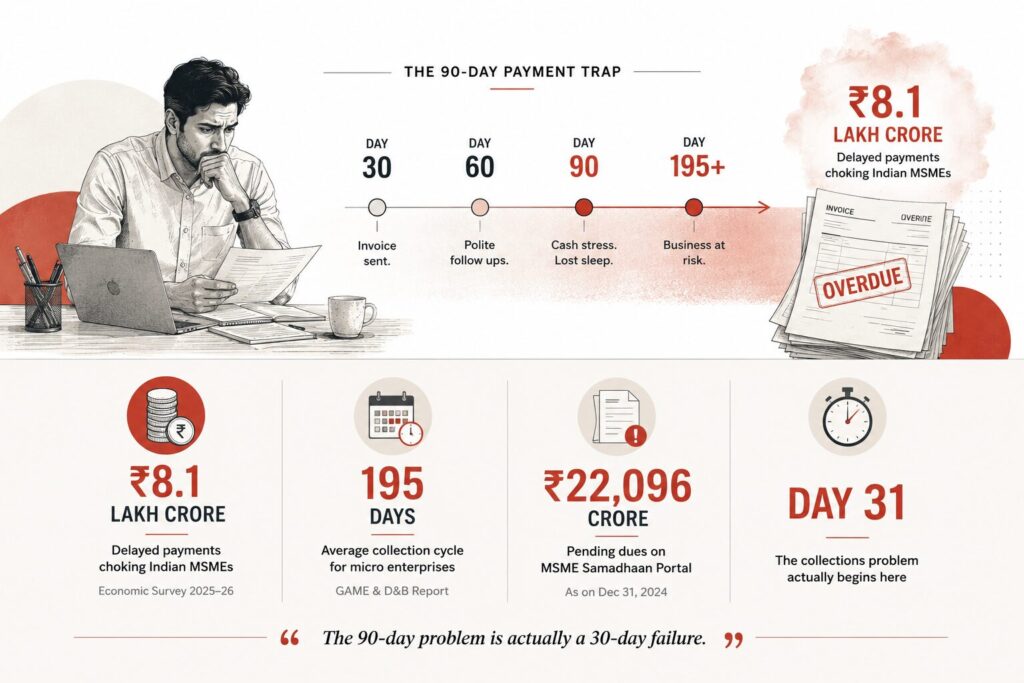
That is the value of delayed payments currently choking India’s MSME sector, according to the Economic Survey 2025-26, tabled in Parliament as recently as January 2026. To put that in perspective: it is roughly equivalent to the combined GDP of Sri Lanka, Bangladesh, and Nepal. It is not trapped in bad debts or legal disputes — it is simply money that has been delivered, work that has been done, and invoices that have been issued and quietly ignored.
Yet when you ask an agency founder in Pune, a technology consultant in Bengaluru, or a marketing firm owner in Mumbai how they handle overdue payments, the conversation hits a familiar wall. Voices drop. Eyes look sideways. “I don’t want to seem pushy.” “It’s a good client.” “I’ll give it another week.”
That week becomes a month. That month becomes a quarter. And somewhere around day 90, the founder is simultaneously cash-stressed, emotionally conflicted, and thoroughly confused about why good work hasn’t translated into the simple dignity of being paid for it.
Here is the uncomfortable truth: this is not a cash flow problem. It is a leadership problem. And until Indian SME founders name it correctly, they will keep funding their clients’ working capital with their own anxiety.

Scene One: The Agency That Waited
Picture this — and if you’ve been running a B2B services business in India for more than two years, you’ve probably lived this in some form.
Riya runs a twelve-person digital marketing agency in Pune. In October last year, she completed a three-month brand campaign for a well-known mid-sized consumer goods company. The work was good. The client said so, repeatedly. The invoice — ₹9 lakhs — went out the day the campaign wrapped.
November came. A polite WhatsApp: “Just checking if the invoice reached the right person?” The client’s marketing head replied warmly: “Yes yes, it’s in process.” December arrived. Another gentle nudge. The reply: “Finance is a bit slow this quarter, you know how it is.”
By January, Riya had hired a new designer anticipating the payment, taken a short-term loan at 18% per annum to cover payroll, and was visibly anxious every time the client called — because every call felt like it might be the one where she’d have to say something awkward and “lose the relationship.”
She never did say anything direct. The payment came — in bits, over four months. The client placed no new work. The relationship, which she had treated as too valuable to risk with an honest conversation, dissolved anyway.
Riya’s story is not unusual. It is, in fact, the statistical norm. According to research cited by the ‘Global Alliance for Mass Entrepreneurship (GAME) and Dun & Bradstreet (D&B)’ Delayed Payments Report (which informed the government’s own 2026 Economic Survey findings), micro-enterprises in India wait an average of 195 days to receive cash for credit sales. Small enterprises wait 68 days and medium enterprises wait 47 days. These are not outliers — they are the operational default of an ecosystem that has never been honest about what late payment actually costs.
Why Indian Business Culture Makes This Harder
India’s B2B economy runs on relationships. Business flows through trust networks, referrals travel over chai, and long-term partnerships often carry more weight than contracts. This is a genuine competitive strength — but it also creates a structural cognitive trap for small business owners.
The trap is this: the conflation of commercial relationships with personal ones.
When a founder avoids following up on a ₹20 lakh invoice, what is really happening is a distorted social calculation — the belief that asking for money disrupts a human bond. The Economic Survey 2025-26 acknowledged this dynamic with unusual directness: “When an MSME files a delayed payment case against a buyer, it may strain or even damage the business relationship. Buyers may perceive the filing as an adversarial step and may stop placing new orders or discontinue the partnership altogether. Since MSMEs rely heavily on long-term commercial ties, the fear of losing future business prevents them from pursuing legal options, even when large dues remain pending.”
That a Union Government economic document felt the need to articulate the psychology of a collections conversation tells you something important: this fear is systemic, not individual.
But here is the assumption that deserves to be challenged head-on: does being firm about payment actually damage relationships?
The evidence and the lived experience of high-growth service businesses say the opposite. What damages relationships is the unspoken resentment that builds when you have waited too long, followed by either a desperate, emotionally charged request or a permanent silence. Clarity, delivered early and professionally, is almost never relationship-ending. Ambiguity, tolerated over months, almost always is.
Scene Two: The Consultant Who Changed His Terms
Vikram is a management consultant based in Mumbai who spent five years building a boutique strategy firm. For most of that time, he operated on 30-day payment terms, chased invoices reactively, and carried receivables that averaged 75 days. His firm was profitable on paper and perpetually cash-stressed in practice.
Three years ago, he made a single structural change: he introduced a 40% advance on all engagements, invoiced the remaining 60% in two milestone-linked tranches, and added a one-paragraph late payment clause to his standard agreement — not aggressive, just clear. He also changed the framing entirely. In his first commercial discussion with new clients, he now says: “Here’s how we typically structure our engagements — it keeps things clean on both sides.”
The result was not that clients walked away. Two clients pushed back on the advance. One he lost. One he negotiated down to 25%, and that client has been his most consistent retainer ever since. His average collection period dropped from 75 days to 28 days. And when an invoice does run late, he follows up on day 8 — not day 45 — because he set the expectation before the engagement started.
The lesson Vikram draws is simple:
“The best time to have the money conversation is before you’ve done any work. After delivery, you have no leverage and a lot of sentiment.”
The 90-Day Problem Is a 30-Day Failure
Let’s be precise about when collections crises actually begin, because most founders misdiagnose the moment of failure.
It does not happen at day 90. It happens at day 31.
The invoice was due on day 30. On day 31, a founder sends a polite, slightly apologetic email: “Hi, just following up on Invoice #1042 — no rush, just checking!” The client reads it, intends to action it, and doesn’t. Day 45 arrives. Silence. Day 60: another hedged nudge. By day 90, the founder is simultaneously embarrassed, financially stressed, and unsure whether a third message will “push them over the edge.”
According to B2B collections research, the likelihood of full payment recovery without significant difficulty… escalated conversations, disputes, or write-offs — drops substantially once an invoice crosses the 90-day mark. The businesses that get paid on time are not the ones with the best client relationships. They are the ones who act at day 8, not day 91.
Meanwhile, the downstream cost of waiting compounds silently. Delayed payments force MSMEs to delay their own supplier payments, reduce orders, or access expensive short-term credit — with informal lending rates sometimes reaching 3–5% per month. The Coface Asia Payment Survey 2025, which covers over 2,400 companies across Asia-Pacific including India, found that ultra-long payment delays (exceeding 2% of annual turnover) hit a new high of 40% of companies in 2024, up sharply from 23% the previous year.
For small businesses operating on 5–10% margins, an ultra-long delay is not an inconvenience. It is an existential event.
The Invisible Leverage Problem in Service Businesses
For agencies, consultants, technology firms, and professional service providers, there is an additional layer of complexity that product businesses do not face. Unlike a supplier who can withhold the next shipment, a service provider cannot repossess delivered work. A campaign has run. A software module is deployed. A legal brief has been filed. The strategic report has been presented.
This creates what might be called the service business receivables trap: the higher the quality of your delivery, the more completely you hand over leverage to your client the moment the work is done.
This is precisely why the architecture of the engagement — how you structure milestones, advances, contracts, and payment triggers — is not an administrative function. It is a strategic one.
Section 43B(h) of the Income Tax Act, effective from April 2024, mandates that companies settle dues to registered MSMEs within 45 days to claim those payments as tax-deductible. This is a meaningful policy step — but it applies primarily to registered MSME vendors, and is largely silent on the freelancer-to-enterprise or boutique agency-to-large-corporate relationships that define much of India’s professional services economy. Policy is a safety net. It is not a substitute for commercial discipline.
The Practical Playbook: Five Moves That Change the Dynamic
The most important shift any founder can make is to move collections from the emotional register to the operational one. Payment follow-up is not a confrontation. It is a business process — and like all processes, it should be designed rather than improvised.
- Move 1 — Have the money conversation before the work starts. Discuss payment structure, milestones, and advance requirements in the first commercial meeting. Not buried in a PDF. Out loud, in person or on a call. This conversation, done once and done clearly, filters out clients who never intended to pay on time.
- Move 2 — Invoice on the day of delivery, not a week later. Every day you delay invoicing is a day you add to your own collection cycle. Issue the invoice the same day you deliver, with a clearly stated due date (not “due on receipt” — that phrase means nothing), your banking details, and a one-line note on your standard follow-up process.
- Move 3 — Follow up on day 8, not day 45. A neutral, professional reminder seven to eight days after the due date is not aggressive. It is expected in well-run organisations. The tone: “Invoice #1042 for ₹X was due on [date]. Please find the details below. Let me know if there’s anything you need.” No apology. No hedge.
- Move 4 — Ask for a specific commitment, not a vague assurance. At day 15 post-due, the follow-up escalates from reminder to request for a date: “Could you confirm when we can expect this to clear? If there’s a specific constraint, happy to discuss a revised timeline.” The word “specific” matters — “we’ll process it soon” is not an answer. A date is.
- Move 5 — Escalate the channel, not just the tone. At day 30 post-due, move beyond the relationship contact to include a finance or accounts payable contact. Keep it matter-of-fact: “Copying in our finance team as we need to close our books for the quarter.” This is not aggressive. It is how functioning businesses operate.
Scene Three: The Founder Who Got Paid — and Kept the Client
Ananya runs a technology consulting firm in Bengaluru. A large enterprise client owed her ₹35 lakhs — 90 days overdue. The client was a meaningful account. She was convinced that any firm action would end the relationship.
Instead of an emotional call, she wrote a crisp, two-paragraph email to the CFO (not the project sponsor who had become a friend over two years): “I’m writing regarding Invoice #2210 for ₹35 lakhs, now 90 days overdue. I’d appreciate your help in clearing this by [specific date]. Please let me know if there’s a process issue I can assist with.”
The CFO replied within 24 hours. The payment cleared in a week. The project sponsor called her shortly after — slightly embarrassed, but not upset. Three months later, they brought her a new engagement.
The relationship survived not because she was gentle. It survived because she was professional.
The Deeper Leadership Lesson
There is a broader challenge here for Indian SME leadership: building an organisation where accounts receivable is treated as a C-suite concern, not an administrative afterthought.
Many growing companies assign collections to their most junior staff member, or leave it as a floating responsibility that everyone assumes someone else is handling. The MSME Samadhaan Portal — the government’s digital dispute resolution mechanism — had over 2.56 lakh applications filed since its inception, with ₹22,096 crore in pending dues as of December 2025, according to data tabled in Parliament. Each of those applications represents a business relationship that had already broken down long before the legal process began.
Better to build the internal architecture early than to inherit the external crisis late.
The state of your receivables is a diagnostic of your business’s strategic clarity. If you have chronic collections problems, the root cause is almost never client malice. It is almost always ambiguous commercial terms, delayed invoicing, inconsistent follow-up, and the cultural silence around money that Indian professional culture sometimes rewards as politeness.
Your client hasn’t paid in 90 days. That is a fact.
What happens next is entirely a choice you make — and the sooner you make it clearly, calmly, and without apology, the more likely you are to both get paid and keep the client.